You have 0 items in your cart





Feeding a pregnant mare properly is much more than “an extra scoop in the manger”. What your mare eats during pregnancy determines to a large extent how fit she will go into labor and what start her foal will get. Precisely because so much happens in her body in those eleven months, it is good if you know exactly what to look out for and how to support her as well as possible with nutrition.
In this blog we take you from the positive scanning moment to the delivery. We explain what changes in the different phases of gestation, which nutrients are important then and how to translate that in practice to the ration in the feed trough.
A mare’s pregnancy lasts an average of eleven months. During that time, her body is constantly changing, but not everything happens at once. It helps to look at gestation roughly in three phases.
In the first three months, the embryo is still small. On the outside you often see little and also in terms of energy needs the mare does not yet differ that much from a non-pregnant horse. This is the phase when you mainly want to get the basics right:
Extreme supplementation is not necessary here; a balanced ration is.
Between months four and seven, the foal’s growth gains momentum. The skeleton and organs continue to develop and the need for protein and certain minerals slowly begins to increase. The mare does not yet need large amounts of extra feed, however:
This is the time to check: is my forage correct, is she getting enough protein, and are vitamins and minerals properly covered?
In the last three months, things are moving quickly. About 60 to 70 percent of total foal growth now occurs. The mare’s energy and protein requirements are rising substantially, as are the demand for calcium, phosphorus, magnesium and trace elements such as copper, zinc and selenium.
At the same time, the space in the abdomen decreases, allowing the mare to absorb less volume. Every bite must now be utilized to the fullest:
At this stage, you really make the difference toward a smooth delivery and a vital foal.
Whatever phase you look at: roughage is and always will be the basis. For the horse in general, but especially for a carrying mare.
Horses are naturally made to eat small bits of fiber-rich feed for many hours a day. That fiber:
Too little roughage increases the risk of gastric ulcers, colic and stereotypic behavior – problems you really want to avoid in a pregnant mare.
As a guideline, you can assume about 1.5 to 2 kg of roughage (dry matter) per 100 kg of body weight, adjusted for her condition and the quality of the roughage. If your hay is very poor or dusty, that is the first point to address.
We like to work with mixed forage: a mixture of different roughage components, combined with an optimal amount of oil. This fits nicely with the horse’s natural needs:
Especially in the last months of pregnancy, when space in the belly becomes limited, such a compact, nutritious roughage base is worth its weight in gold. You don’t then have to stuff your mare with starchy pellets to still meet her energy and nutritional needs.
From mid-pregnancy onward, the mare’s energy requirements slowly increase, with a marked peak in the final months. Still, “more, more, more” is not automatically better.
A mare that goes into labor too thin is more likely to be exhausted. But a mare that is too heavy, in turn, carries more risk of joint strain and complications around delivery. So it’s all about a healthy middle ground: fit, but not fat.
When increasing energy intake, the preference is for good roughage of consistent quality with additional energy from fat/oil and high structure, low grain concentrate feeds rather than large portions of starchy kibble.
The foal builds its muscles, organs and connective tissue from amino acids. In mid and especially late gestation, the protein requirement increases markedly. This is not just about “lots of protein,” but especially about easily digestible protein sources, raw materials that really suit the horse and a ration without unnecessary fillers.
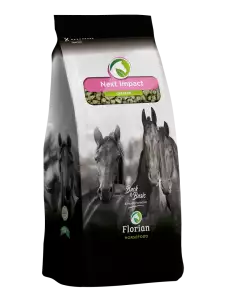
This is where a product like Next Impact Oerbrok comes into focus nicely. This cold-pressed primal pellet was developed on the premise of “don’t fill, but feed.”
Next Impact is therefore a practical way of adding extra energy and quality protein without overloading your mare with starch. Especially in mid and late gestation, this can make the difference between “just enough” and optimal support.
Minerals and trace elements largely determine the quality of bones, joints, muscles and the foal’s immune system.
Key elements:
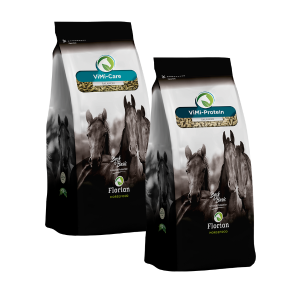
In many roughages, the content of certain minerals is variable or on the low side. Therefore, a vitamin and mineral balancer for pregnant mares is not a luxury, but indispensable. This allows you to supplement targeted deficiencies without immediately feeding large amounts of concentrate.
Every mare is different, but you can translate the theory fairly easily to the feed wagon. In doing so, always note:
In the early gestation, you mainly make sure the basics are right:
Keep fitness stable: don’t suddenly lose weight, but don’t deliberately fatten up either.
If you notice between months four and seven that your mare is slowly starting to fall in, this is the time to make adjustments. You can think about:
Instead, for mares that get heavy quickly, you can use Next Impact more as a compact dietary enhancer in smaller portions, combined with plenty of textured roughage and plenty of exercise.
In late gestation, you reinforce the same principles:
Major changes in feed you now set precisely nil; what you adjust, you always do gradually.
Toward the end of pregnancy, you want the mare to not only have adequate reserves, but also to be physically and mentally balanced.
A stable gut flora:
Roughage of consistent, good quality – preferably sun-dried and free of mold – plays a key role in this. Do not suddenly change the type of roughage or concentrate just before giving birth; always introduce changes gradually.
During labor, the uterine muscles must be able to work efficiently and the mare must be able to relax between contractions. Mineral balance plays into this:
With a well-thought-out ration and an appropriate balancer, you work toward this in the months before birth.
Especially in the final stage of pregnancy, unlimited fresh drinking water is essential. In warm weather or when your mare is still getting some light exercise, a lickstone or extra electrolytes can help keep the fluid and salt balance in order.
Despite good care, your mare may become too skinny or too round, or her coat, hooves or energy level may not please you. These are signs to take seriously.
Among other things, note:
If you see one or more of these signs, it is wise to take a close look at the complete ration: roughage, concentrates, balancers and any treats. A roughage analysis and advice from a nutritionist can then make a lot clear.
How Florian can support you
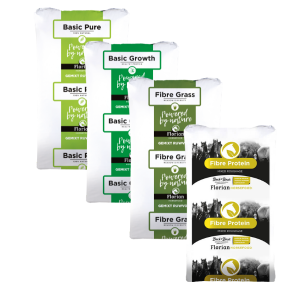
Our mission is simple: to help horses thrive. For pregnant mares, that means a ration that follows their natural needs, with blended forages as the foundation and concentrates and balancers formulated from the horse’s point of view, not fillers.
We therefore work with:
Want to know if your mare’s feed is appropriate for the stage of her pregnancy? Feel free to send us a rundown of what she’s getting now, including a few photos of her condition. We are happy to work with you on a practical, achievable plan that will help your mare go into labor and delivery prepared and balanced.
From feeding to foaling, having the right foundation will give her everything she needs for that final leap into motherhood.
Discount Applied Successfully!
Your savings have been added to the cart.