You have 0 items in your cart





Summer eczema is triggered by midges. That’s clear. And yet for many horse owners, it feels like that’s not the whole story. One horse seems to be “just having some trouble” and another horse is on edge from the first warm weekend. As if the body is already ready to respond.
And often that feeling is true.
Not because food causes summer eczema, but because the body’s reaction is influenced by what is happening inside. Especially in the intestines. Who our blog “Master itching? Here’s how nutrition helps tackle summer itch! “ already read, know that in Part 1 we explained the basics and practical approaches. In this second part, we go a layer deeper, to understand even better where the “volume knob” is, so you can make more targeted adjustments.
We discuss the role of IgE and histamine (the allergic pathway) and the microbiome and gut wall (the internal environment that determines how irritable the immune system is). Includes a term you hear more and more often: leaky gut. What exactly do we mean by that and, more importantly, what don’t we mean?
Summer eczema is, at its core, an allergic reaction to the saliva of midges. The bite is the trigger, but the severity of symptoms is determined by the body’s reaction. Compare it to a smoke alarm. In one house, it doesn’t go off until there is actual smoke. In the other house, it beeps at just a little steam from the kettle.
That difference is exactly where it gets interesting. Because you can’t always avoid midges. What you can influence, however, is how fast the system jumps on and how long it stays on.
If you plot summer eczema biologically, you quickly end up with IgE. IgE is an antibody involved in allergic reactions. Very briefly, in an allergy, the body sees something harmless as a threat and builds an exaggerated reaction to it.
IgE acts as an alarm substance that attaches to immune cells that lie as guards in tissues, including mast cells. Once there is renewed contact with that “trigger” in this case knut saliva, that alarm can go off. Mast cells then release a variety of substances meant to defend, including histamine.
Note: Manure cells, by the way, have nothing to do with horse manure or feces, but is a name for a specific type of cells involved in the immune system. They are a kind of sentry cells that react as soon as they perceive an intruder.
Histamine is not bad in and of itself. It is a normal signaling substance in the body. But in an allergic context, histamine can contribute to exactly the symptoms that drive you crazy as an owner: itching, redness, swelling and irritation. It also explains why summer eczema is not just a skin story. It is an immune story that becomes visible on the skin.
Therein lies immediately the bridge to nutrition. Because the immune system does not react in a vacuum. It reacts within the context of the total load on the body: how many stimuli does it receive, how calm is the system, how stable is the internal environment?
And that internal environment is largely influenced by … the gut.
In our blog “Healthy gut, strong resistance,“ we describe the gut as a border post: everything your horse ingests passes through there, and around that border post much of the immune activity happens. The gut is the place where the body must continually decide: do we let this pass, or should we react?
To understand that link to itching, two concepts are important: the microbiome and the gut wall.
The microbiome is the ecosystem of bacteria and other microorganisms in the intestines. In horses, that ecosystem is crucial because the horse is designed to ferment fiber. A stable microbiome not only helps with digestion, but also influences how the immune system responds. You can think of it as a kind of internal coach that helps immune cells distinguish normal and safe from abnormal and threatening.
The intestinal wall The intestinal wall is the physical dividing line. That barrier must be selective: letting nutrients through, but keeping unwanted stimuli out. When the microbiome and the barrier work well together, the system stays calm. When that cooperation comes under pressure, the immune system may have more signals to respond to.
And then we come to that term: leaky gut.
“Leaky gut” is sometimes used online as an explanation for everything. That is exactly how not to approach it.
What we do mean by it is this: the intestinal wall can become irritated or less tightly functioning. As a result, more stimulants can pass through it than is desirable. The immune system, which lies around that barrier, then simply gets more to process. Not because the immune system is bad, but because it has to work harder.
If you translate that to itching and summer eczema, you arrive at a logical hypothesis (and note that this remains “may contribute to”): an immune system that is already “on” more often may respond more sensitively to an additional allergic trigger such as midge saliva. With that, the IgE/histamine response may escalate more quickly.
This does not mean that every itch comes from the gut. But it does mean that it makes sense to take the foundation with you when you notice that your horse is itching a lot every spring.
Many horses face several changes at once around the start of the season. More grazing. Young grass. More sugars and fructans. Sometimes a forage change. And on top of that: more bugs and more heat.
In Part 1, we already explained that fructans are not always processed properly in the small intestine and end up in the large intestine, where fermentation takes place. If that supply is too large, the intestinal flora can shift and more lactic acid can be produced. The acid then attacks the intestinal wall and the immune system is additionally triggered. That type of shift is exactly the type of change that some horses react sensitively to.
All this together can create a domino effect: Digestion becomes more agitated, the intestinal wall is under pressure, the immune system receives more signals. And then a midge bite comes on top of that. The trigger is the same as always, but the substrate has changed. The system is already tuned higher.
This is the reason you sometimes see that a horse is not only more itchy, but also looks just not quite fit: fluctuating manure, a coat that is less shiny, quicker irritable behavior or less recovery.
If you understand the biology behind itching, the practical conclusion is actually surprisingly simple: you are looking for peace and stability. Not for a magic ingredient.
Roughage is the basis of the digestive engine. And because it is the biggest factor in the ration, it is also the biggest factor in stability. Therefore, especially for horses with itching, it is smart to not only look at supplements and concentrate, but especially the basics: what roughage am I feeding and what has changed in it?
A roughage check helps you look at things objectively. Not to make it complicated, but to remove noise. Especially in seasonal transitions, that can make a huge difference.
With itching and hypersensitivity, you often see that the system does not go well on large spikes of fast carbohydrates. Feeding less sugar/starch can then contribute to more calm fermentation and therefore a less irritable internal environment.
But here’s a major pitfall: cutting out everything and hoping it will clear up. If you remove too much and create shortages, you put a different kind of stress on the body. That’s why fewer stimuli is only smart if you do keep the basics in order in the meantime.
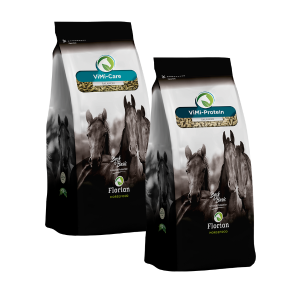
Many horses that are sensitive are (rightly) fed little or no traditional concentrates. Only: modern forage is not as varied as the horse’s natural menu. This can cause deficiencies in vitamins and minerals. ViMi-Care was developed to supplement that foundation: an essential vitamin and mineral balancer with timothy as a carrier, with esparcette and linseed, and free of unnecessary substances such as molasses, alfalfa, (whole) grains and soy.
The effect of this should not be seen as anti-itch, but as: keeping the basics up while lowering stimuli.
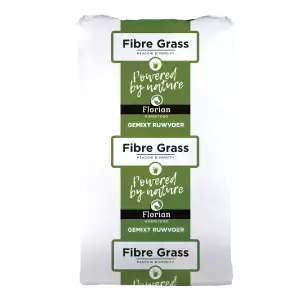
For horses that are sensitive around grass changes or see itchiness flare up in season, extra structure and fiber is often a logical step. Fibre Grass is a roughage mix that is grain-, soy-, molasses- and alfalfa-free and very low in sugar and starch. In addition, it is described as high in structure, with extra chewing stimulation.
In plain language, it helps keep your ration structure-rich and stable, especially when the grazing season begins again.
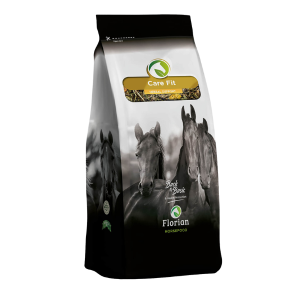
Sometimes, in addition to a good foundation, additional seasonal support is desired. Care Fit is a herbal mix that supports the cleansing action of liver and kidneys, is very low in energy, sugar and starch and contributes to improved intestinal flora and resistance.
Again, it works best when it is embedded in a correct overall picture, not as a loose trick.
Summer eczema is an allergic reaction to midge bites. But the ferocity of the reaction is influenced by the excitability of the immune system. And that immune system is strongly controlled from the intestines: via the microbiome and via the intestinal wall. When those are under pressure, for example, in the spring due to more sugars/fructans and ration changes, the system can “turn on” faster and an IgE/histamine reaction can be more severe.
Therefore, the practical message is not: find the perfect “anti-itch” ingredient. The practical message is: build rest. Start with forage, reduce sugar/starch without creating deficiencies, put in a good balancer, add structure/fiber where needed, and choose seasonal support to supplement the foundation.
Do you want to find out specifically if your horse’s ration may play a role in itchiness, and what adjustment will give the most peace of mind?
Start with the FeedCheck Or choose directly for Nutritional advice. Then we’ll look with you at roughage, pasture, concentrate and the details that can make a difference with your horse.
Discount Applied Successfully!
Your savings have been added to the cart.