You have 0 items in your cart



You train properly, pay attention to the feed, and do your best to keep your horse in good condition. Yet that one feeling keeps nagging: why do I see so little muscle development? Why is the topline lagging behind, does your horse still look a bit thin, or does it feel like all your efforts are yielding less than you had hoped?
That is frustrating, but fortunately, a cause can often be identified. After all, muscle building rarely depends on a single factor. In practice, it is usually a combination of nutrition, training, recovery, digestion, and management .
In this article, we list the 7 most common causes of lagging muscle development. This allows you to look more specifically at where improvements can be made with your horse.
Before we look at the causes, it is good to have one thing clear: you do not build muscle with training alone, nor with food alone.
For muscle building, a horse needs, among other things:
Only when those puzzle pieces fit together properly do you often see a real difference.
Muscles are built from proteins . If a horse ingests too little of this, or if the quality of the protein is insufficient, muscle development can lag behind.
What do we mean by protein quality? Protein is a collective term for various substances with a similar structure, and not every protein is the same or produces the same result. These proteins are made up of amino acids. A horse’s body requires 20 types of amino acids to subsequently produce all the proteins its body needs. It is therefore important that a horse ingests all these amino acids. Consequently, a protein source that is too one-sided does not provide all the amino acids a horse needs.
That does not mean you have to feed more. It is mainly about the question: is your horse receiving the right nutrients, appropriate to his needs? Those needs may be higher in cases of, for example:
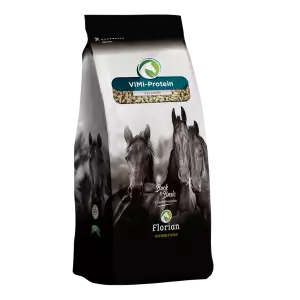
Within our range, for example, we have developed the ViMi-Protein Balancer as a protein balancer for building and maintaining healthy muscles, and it is specifically given to young horses, sport horses, and older horses with a higher protein requirement.
Don’t just look at how much feed you give, but especially at the overall composition of the ration. Hay, roughage , concentrates, and any supplements must work together.
This is a point that is often underestimated. A horse may well ingest sufficient protein, but if there is too little usable energy in the ration, muscle building will still be difficult.
You can compare it to building without fuel: you have materials, but insufficient capacity to really do anything with them.
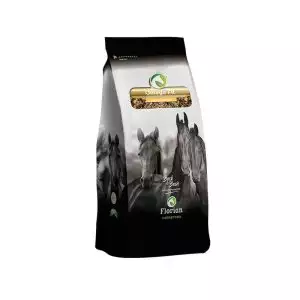
Some horses therefore need extra support not only in protein, but also in energy that matches their work and metabolism . Power Fit is a support mix with plenty of high-quality protein and energy from carbohydrates, intended to provide strength and support muscle building.
A horse that struggles to gain muscle mass does not always need just “more protein.” Sometimes the gains lie precisely in a better-balanced total ration.
Nutrition alone does not build muscle. Without a training stimulus, the body has no reason to build extra muscle mass.
That does not necessarily mean your horse has to work harder. Much more often, the gains lie in working in a more targeted way . A horse that mainly walks the same circle, receives little variety, or does not work correctly over its back will build up beautiful muscle mass less quickly than a horse that is trained appropriately and thoughtfully.
Consider, for example:
More training is not automatically better training. It must suit the horse in front of you. Age, physical capacity, level, and sensitivities all play a role.
Muscle building does not only happen during work, but especially afterwards . During training, you stress your muscles; afterwards, the body needs to recover and adapt.
If a horse does not get enough time for that, you often see muscle development stagnate. Sometimes you notice it subtly:
Fluid loss and electrolyte loss can also play a role in this, especially in warm weather or during more intense work.
Good muscle building requires a rhythm in which training and recovery are in balance. Rest days are not a step backward, but an important part of progress.
Sometimes a ration seems fine on paper, but the horse still does not utilize the feed optimally. In that case, digestion can play a role.
Healthy digestion is important for:
If gut function is out of balance, it can affect how a horse processes food. And what is not properly digested or absorbed cannot contribute effectively to muscle building.
Does your horse suffer from a sensitive digestive system? Then first ensure that the quality and feeding of your roughage are optimal. Provide sufficient variety in fiber, and only then start feeding more energy and protein. We say for a reason: Don’t fill, nourish 😊.
Consider:
Then it is smart not only to look at muscle building, but also at the foundation underneath.
Not every horse that is low in muscle simply needs “more feed, energy, or training.” Sometimes other factors play a role, such as:
A horse that does not move comfortably will usually also develop its musculature less well. Then you can feed it whatever you want, but the results will lag behind.
Horses that have been injured in the past also sometimes find it difficult to use their bodies optimally again. In that case, focus first on comfort in the body. With appropriate training, you can help the horse experience that the pain is truly gone. And if in doubt: always have a veterinarian or physiotherapist take a look!
Is muscle building failing to materialize? Then it is wise to assess the bigger picture:
That is precisely where significant gains are often to be found in practice.
This might not be the most enjoyable cause, but it is a very important one: building muscle takes time .
Many horse owners hope to see a clear difference within a few weeks. In reality, muscle development is usually gradual. First, you often see small changes in:
Only then does it become more (permanently) visible in the body.
A horse that has had little muscle mass for a long time will not rebuild it in a few training sessions. Consistency, rest, and an appropriate approach are much more important than quick fixes.
If your horse is not building much muscle, it is smart to look at the basics step by step.
It is not just how much you feed that counts, but especially whether the total is correct.
Those two belong together. Giving only extra protein is not always enough.
Goal-oriented, varied, and tailored to your horse.
Rest, hydration, and balance after work are indispensable.
A horse must also be able to utilize feed properly.
Management, comfort, health, and work are all interconnected.
Sustainable muscle building usually doesn’t happen quickly, but it certainly does.
For some horses, the basics are in order, but the needs are simply higher. Think of young horses, sport horses, older horses, or horses that could use extra support with muscle development or condition.
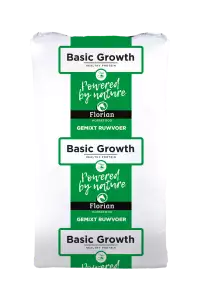
Within Florian Horsefood, there are various products that can suit this, depending on the horse and the situation:
What is suitable always depends on the total ration, the type of horse, and the work you ask of him. Are you unsure what the best choice is for your situation? Feel free to contact us, and we will be happy to help you figure it out.
If your horse is not building muscle, it is rarely due to a single thing. In practice, it is usually a combination of feed, energy, training, recovery, digestion, and overall balance .
You usually don’t take the biggest step forward by blindly feeding more, but by looking more specifically at what your horse really needs.
Because every horse is different, and that is precisely why a tailored approach works best.
Discount Applied Successfully!
Your savings have been added to the cart.