You have 0 items in your cart





You probably recognize it: on paper your horse is doing everything right, but something is wrong. The manure is fine one week and just too wet the next. The coat shines less than you are used to. Or you notice that he reacts faster to stimuli: a little bit of stress and it seems as if his whole system joins in. Sometimes it’s itching, sometimes respiratory sensitivity, sometimes just that feeling of just not feeling fit.
The difficult thing about these types of complaints is that they rarely have one clear cause. But there is one place where many of the pieces of the puzzle do come together: the intestines.
We say for a reason: health starts from the inside out. Not because the gut solves everything, but because that’s where it starts. In this blog, we’ll take you through the relationship between healthy digestion and the immune system.
Your horse’s immune system has one big job: to distinguish between what is safe and what is not. And if you think about that for a moment, it actually makes perfect sense that the gut plays a leading role in this. Much of the immune activity happens around the gut, simply because the gut is in contact with the outside world all day long. Everything your horse ingests, such as feed, water, as well as bacteria, fungi and dust particles, passes through the gastrointestinal tract.
So the gut is not just a digestive tube. It is also a kind of border post. A place where the body must constantly decide: do we let this pass? Or should we react? When that border post is working properly, your horse can absorb nutrients without the immune system unnecessarily going on the defensive. In fact, a healthy gut flora trains the immune system to distinguish healthy nutrients from pathogens. When things get messy there, the immune system is less well trained and receives more stimuli. You can eventually see that reflected in all kinds of signals: sometimes very obvious in the manure, sometimes just in places where you don’t immediately expect it.
Horses are made to process small bits of high-fiber feed almost continuously. Not for two big meals a day, not for big peaks and valleys, but for a steady stream. And that flow naturally consists primarily of crude fiber: fiber.
Based purely on your horse’s physiology, everything starts with roughage. A horse gets much of its energy from fermenting fiber in the blind and large intestines. Billions of microorganisms live there and help digest that fiber. We call that ecosystem the gut flora, or microbiome.
And that microbiome is sensitive to change. For example, if you change the feed lot, if your grazing suddenly increases, if your horse experiences tension or if you change several things at once in a short period of time, the flora has to change with it. If it does so smoothly, you won’t notice much. But if the change is too big or too fast, the system can become restless. And agitation in the gut is rarely seen only in the manure.
To really understand the link to resistance, it helps to pull apart two parts: the gut flora and the gut wall.
You can think of the gut flora as the inhabitants of a city. If the right inhabitants are balanced and given enough good food (fiber, structure, regularity), they keep things tidy. They help with digestion, but they do more: they produce substances that support the gut wall and they influence how the immune system behaves.
The intestinal wall itself is the city wall. It does not consist of a single layer, but of a clever set of cells and protective mucus layers. In and around that intestinal wall are also many immune cells. These are not there to constantly make trouble, but to monitor what happens. You can compare it to security watching all day long: “Is this normal traffic, or is this something we need to respond to?”
If the intestinal flora becomes unbalanced, or if the intestinal wall is irritated, it can lead to a situation where the immune system is “on” more often. Not because the immune system is bad, but because it has to process more signals. And that can contribute to a horse becoming more susceptible to overreactions, or a horse simply staying less well balanced.
Many people don’t notice intestinal problems until the manure changes. And honestly: that’s also the most visible signal. But it’s not the only one.
Some horses show agitation in digestion as a dull coat or troublesome shedding. In other horses, it’s the skin: a horse that is more prone to itching or that you feel is more responsive. And still others show it in their energy: no pronounced lameness, no obvious illness, but just … less fresh. Less recovered, more quickly irritated, more quickly on.
It is important to remain level-headed about this. Not every itch comes from the gut. Not every dip in energy is a feeding problem. But if you see multiple signs at once, and especially if they recur around feed changes, stress or seasonal transitions, it makes perfect sense to take a fresh look at your horse’s foundation.
In practice, we find that many horses are more sensitive around periods of transition. This is because several things often change at the same time then.
Maybe there will be a new batch of hay. Maybe your horse suddenly goes outside more and eats more grass. Maybe the training changes. Or just the routine: more indoors, less exercise, different times. And even something as simple as drinking behavior can fluctuate with temperature and management.
For the gut, that’s quite a lot. And for the immune system as well. Therefore, creating rest during these periods is often more valuable than adding yet another stimulus.
The nice thing is: you don’t have to make it complicated. In fact, most of the gain is in three things: a strong fiber base, predictability and smart adjustments rather than big leaps.
If there is one place where you have the most influence, it is roughage. Sufficient and varied roughage, suited to your horse, distributed throughout the day and as stable as possible in terms of lot and quality: that is the foundation on which the intestinal flora can build.
When horses are sensitive, you often see that they go best on a forage strategy that provides rest. Not too many changes, not too many peaks, but structure. And that’s exactly why we believe so strongly in forage mixes as a foundation: it allows you to feed targeted for fiber and balance, without relying on a lot of concentrate or quick energy sources.
The gut flora switches with what you feed. That takes time. So a feed change is not just introducing a new product, it’s changing the internal ecosystem. The faster you change, the more likely the system will protest.
So if you want to adjust something, do it slowly. On average, a horse’s microbiome needs 6 to 8 weeks to get used to a new feed or ration. And if your horse is sensitive: rather change one thing at a time. Then you can really see what has an effect.
Digestion is not just nutrition. Stress changes eating behavior, tension affects the whole body and routine is more important to many horses than we think. Water is another basic factor that is easily forgotten, especially in colder periods when horses sometimes drink less. And drinking less can make digestion less smooth.
Because you now understand the background, product selection also becomes more logical. It is not a question of “What is the best product?” but rather: what suits my horse and what is my goal with my horse?
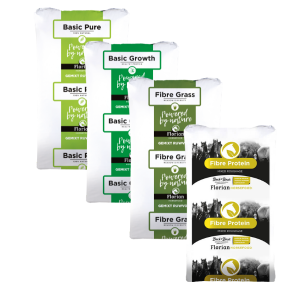
If you are primarily looking for peace of mind and a ration friendly to horses that react quickly with fluctuating manure or general sensitivity, then Fibre Grass is often a very logical base: low in sugars & no fillers. It helps keep the fiber base strong and stable, which is exactly what many sensitive horses thrive on.
Sometimes a horse needs more nutrients. Think of horses that need to build muscle (again), horses that train more intensively, or horses that are in recovery. Then a roughage mix such as Basic Growth or Fibre Protein can be a good fit, because it allows you to provide targeted support in terms of need, without letting go of the foundation of fiber and structure. Basic Growth is best suited for young, old or sport horses with a normal protein requirement. Does your horse lack (a lot of) muscle or does it have a higher protein requirement due to growth, sport or age? Then the Fibre Protein is more suitable.
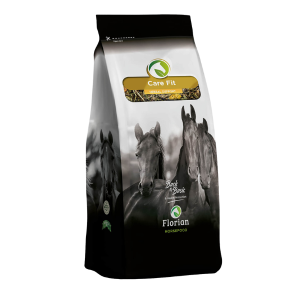
And then there is the Support Mix Care FitCare Fit: intended as support, not as a band-aid on a wobbly base. It fits well in periods when your horse could use some extra support, for example around season changes, during stress moments or when you want to give the overall balance a helping hand while keeping the core firm with roughage and routine. The Care Fit contains only functional ingredients for your horse: not filling but feeding!
Nutrition can mean a lot, but not everything is food. Always contact your veterinarian with obvious alarm signals, such as:
In doubt? Always opt for safety. And once it is medically clear what is going on, it is precisely smart to optimize the ration in addition, so that your horse gets as much rest and recovery space as possible from within.
If you take one thought from this blog, let it be this: digestion and immune systems are not separate islands. The gut is a place where nutrition, microorganisms, gut wall and defenses meet daily. When that interplay is calm and stable, your horse often has more room to stay balanced, even when there are additional stimuli, such as season changes, training or stress.
And the great thing is: you don’t have to guess. You can make the plan based on your horse, your situation and your goals.
Want to know if your horse’s ration suits his digestion, sensitivity and resistance?
Do the Florian FeedCheck and ask an advisor. Then together we’ll look at your forage, your feeding schedule and what forage mix and support is best for your horse.
Discount Applied Successfully!
Your savings have been added to the cart.